
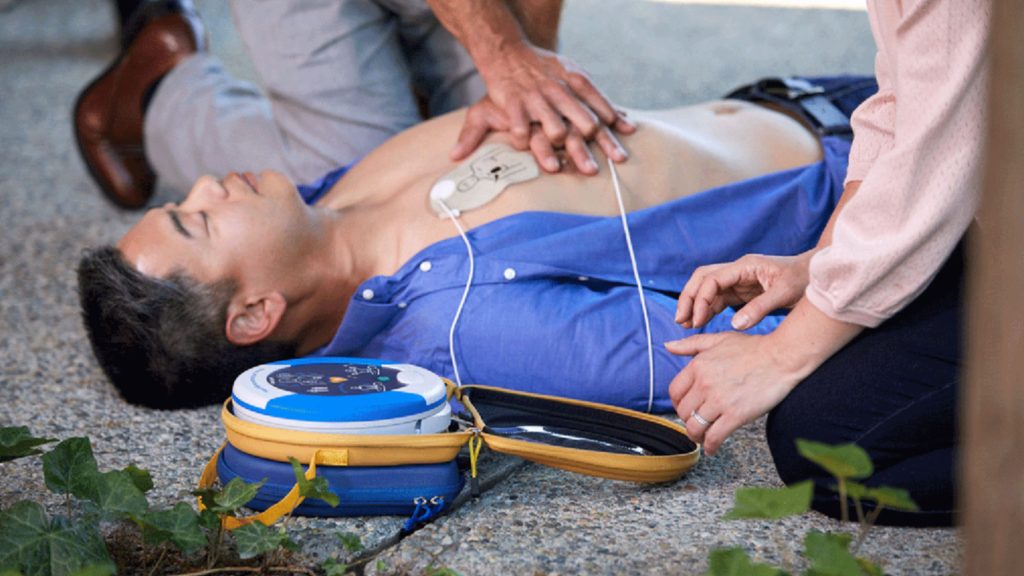
HeartSine Defibrillator: Complete Australian Guide to the 350P, 360P, 500P and Pad-Pak
HeartSine defibrillators have been widely installed across Australian workplaces, schools, sporting clubs, community facilities, vehicles, caravan parks and public-access locations.
The HeartSine defibrillator range is best known for its compact design and combined battery-and-electrode cartridge, called a Pad-Pak. The most common Australian models are the HeartSine samaritan PAD 350P, HeartSine samaritan PAD 360P and HeartSine samaritan PAD 500P defibrillators.
The FAQ below explain:
- – The differences between HeartSine defibrillator models
- – How a HeartSine defibrillator Pad-Pak works
- – Battery and electrode replacement requirements
- – Adult and paediatric operation
- – Maintenance and readiness checks
- – Australian product alerts and recalls
- – HeartSine defibrillator availability in Australia
- – When an older HeartSine defibrillator should be replaced
- – How HeartSine defibrillators compare with newer AED options
Information about recalls, consumables and product availability can change. HeartSine defibrillator owners should always check the serial number, Pad-Pak details and current manufacturer instructions applying to their particular device.
What is a HeartSine defibrillator?
The three commonly encountered HeartSine defibrillator models are the 350P, 360P and 500P.
HeartSine 350P defibrillator
Operation: Semi-automatic
Main Feature: Responder presses the shock button when instructed
HeartSine 360P defibrillator
Operation: Fully Automatic
Main Feature: Delivers the shock automatically after warning everyone to stand clear
HeartSine 500P defibrillator
Operation: Semi-automatic
Main Feature: Includes CPR Advisor feedback for compression rate and force
All three HeartSine defibrillators are designed for public-access use and operate using the HeartSine Pad-Pak system.
Product configurations, accessories, connectivity and Australian availability can vary.
What does HeartSine samaritan PAD mean?
HeartSine samaritan PAD is the official name of the HeartSine public-access defibrillator family.
In this context, PAD means “Public Access Defibrillator”. It does not refer only to the adhesive electrode pads.
The principal models found in Australia include:
Which HeartSine defibrillator models are available in Australia?
HeartSine samaritan PAD is the official name of the HeartSine public-access defibrillator family.
In this context, PAD means “Public Access Defibrillator”. It does not refer only to the adhesive electrode pads.
The principal models found in Australia include:
What is the difference between the HeartSine 350P and 360P defibrillators?
The principal difference is how the shock is delivered.
HeartSine 350P defibrillator
The HeartSine 350P is a semi-automatic defibrillator.
When the HeartSine 350P defibrillator detects a shockable rhythm, it charges and tells the responder to press the illuminated shock button. The shock cannot be delivered unless the defibrillator has analysed the casualty and determined that a shock is appropriate.
HeartSine 360P defibrillator
The HeartSine 360P is a fully automatic defibrillator.
Is the HeartSine 350P or HeartSine 360P defibrillator better?
Both HeartSine defibrillators are designed to provide safe public-access defibrillation. The best model depends on the environment, responder training and organisational preference.
A semi-automatic HeartSine 350P defibrillator gives the responder control over the final moment of shock delivery. This allows the responder to visually confirm that nobody is touching the casualty before pressing the shock button.
A fully automatic HeartSine 360P defibrillator removes the need to press a shock button. However, responders must still follow the prompts and stand clear when the defibrillator warns that a shock is about to be delivered.
For larger organisations, consistency across every location can be particularly important. Having the same HeartSine defibrillator model throughout a fleet can simplify staff training, maintenance and consumable management.
What is different about the HeartSine 500P defibrillator?
The HeartSine 500P defibrillator is a semi-automatic AED with integrated CPR Advisor technology.
In addition to analysing the casualty’s heart rhythm and providing defibrillation, the HeartSine 500P defibrillator gives visual and verbal feedback about the rate and force of chest compressions.
Its CPR instructions may include guidance to:
- – Push faster
- – Push slower
- – Push harder
Continue compressions
The HeartSine 500P defibrillator obtains its CPR feedback through the electrode pads rather than requiring a separate compression puck or accelerometer.
CPR feedback can assist a responder, but it does not replace CPR or first-aid training. Responders should continue following Triple Zero instructions and the HeartSine defibrillator’s prompts.
